

As More States Consider Harsher Penalties for Public Camping, One Man’s Arrest Shows What Enforcement Actually Looks Like
The recent felony arrest of a person experiencing homelessness in Tennessee has revived concerns about the real-life impacts that criminalizing homelessness can have.
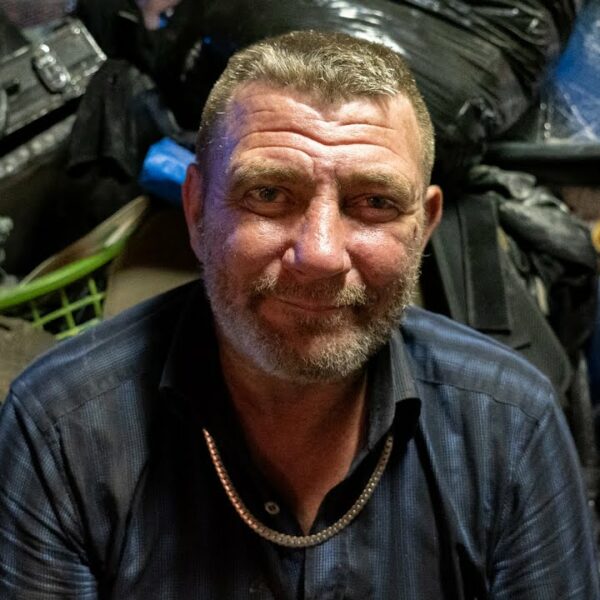
On June 28, Joseph Williams, who has been chronically homeless in East Nashville, was arrested by police officers after he refused to leave a public park where he had lived for several years, NPR reported. Williams was charged with felony camping on public property, a charge made in 2022 when lawmakers increased penalties for public camping.
Tennessee is the only state in the U.S. where public camping is a felony. Williams spent nine days in jail before a judge dismissed the felony charges. After his release, he returned to the same park, evidence that even when a felony camping law is enforced to its fullest extent, it doesn’t accomplish what its supporters claim it will: getting people off the street and into stable housing.
The Think Tank Behind the Crackdown
Tennessee increased penalties for public camping after a sustained lobbying effort by the Cicero Institute, founded by Palantir co-founder Joe Lonsdale. Cicero has been pushing several states to increase penalties for public camping, arguing that the Housing First approach to ending homelessness has “failed.”
Williams’ arrest rankled local advocates like Lindsey Krinks, co-founder of Open Table Nashville.
“Punishing people and using police to address homelessness only makes the crisis worse, and it prolongs people’s experience of homelessness,” Krinks told NPR. “Most people I know experiencing homelessness are so hungry for freedom, for agency, for their dignity to be seen and recognized and understood. Jail erodes every aspect of a person’s agency.”
Devon Kurtz, Cicero’s public safety policy director, told the outlet that there are times when arresting someone may save their life. However, it is unclear whether Williams’ life was in danger when he was arrested.
“My hope is that no one is ever convicted under any of these camping bans,” Kurtz told NPR. “The intention is not to jail people. I’ve also said, however, that sometimes, at the margins, it is essential that law enforcement has the ability to jail them because it can save lives.”
More States Are Following Tennessee’s Lead
Williams’ arrest also happened at a time when several states are considering increasing penalties for public camping, which has raised concerns among advocates that local leaders will try to solve homelessness through arrests rather than housing.
Data from the National Homelessness Law Center shows that at least 22 states have introduced new anti-homeless laws during their 2026 legislative sessions. For example, states like Hawaii, North Carolina, and Wisconsin have considered creating “drug-free zones” around homeless shelters.
The Law Center said these bills create “a two-tiered justice system, punishing people differently for the same crime depending only on whether they sleep outside.”
Indiana also passed a bill that prohibits public camping. The bill requires police officers to remove a homeless encampment within 48 hours of being notified, and violators could be fined up to $500 or given jail time.
Advocates in Indiana defeated the bill four times before it passed. The Law Center argued that the battle showed that “even when Cicero’s bills are deeply unpopular, their billions can buy power and influence.”
Many of these laws were introduced following the Supreme Court’s 2024 ruling in Grants Pass v. Johnson, a case that held that camping bans do not constitute “cruel and unusual punishment” under the 8th Amendment. That ruling seems to have inspired governments across the country to pursue legal mechanisms for removing homeless people from public sight rather than providing housing and services.
Williams’ arrest also raises the stakes in debates about camping bans occurring across the country. Camping bans have been proven to be expensive, legally dubious, and personally traumatic for people who are homeless. There have even been instances when encampment clearings turned deadly, such as the case of Cornelius Taylor, a chronically homeless man in Atlanta, who was crushed by heavy machinery while city crews cleared a camp in downtown.
Arresting people who are homeless also pushes people further from the housing and services they need to find stability. Arrests can impede an individual’s ability to find a rental home, even when they have a housing voucher. Jail sentences can also hinder an individual’s ability to find stable work, or to be welcomed back into a community after they serve their punishment.
Local Leaders Keep Pushing Bans Anyway
Elected officials have continued pursuing public camping bans despite the evidence suggesting they don’t reduce homelessness. In North Carolina, Gov. Josh Stein vetoed the legislature’s attempt to ban homeless encampments on state property only to have the state House of Representatives overturn it, The News & Observer reported.
Stein, a Democrat, argued that the bill was “poorly constructed” and could prevent people who are homeless from “[getting] back on their feet and [living] in safe, affordable housing,” according to the report. Republicans like Speaker Destin Hall said the bill provides “long-term solutions by relocating encampments to safer, more suitable locations.”
A similar debate is playing out a few hundred miles away in Athens, Georgia. The local county commissioners have been debating a measure to increase penalties for public camping, which was eventually voted down because of public pushback.
“‘Move along’ orders are inhumane, extremely expensive and, more importantly, do not work,” Michael Bien, executive director of the Athens Homeless Coalition, told the commissioners, according to a report by local news outlet Flagpole. “People either return to where they were, or they relocate … This doesn’t solve the underlying problem; it shifts it, and each shift makes the person harder to reach.”
These debates illustrate that homelessness is often viewed as a problem to be cleaned up, like debris after a massive storm, rather than a human issue that can be solved through compassion and dignity. Homelessness won’t be solved until that paradigm shift occurs.
How You Can Help
With the Supreme Court’s gutting of essential protections for homeless people, our work is more critical than ever. Nationwide, anti-homeless laws are gaining ground in legislative committees, fueled by hidden votes, corporate backing, out-of-state lobbyists, and conservative think tanks like the Cicero Institute. We’re fighting a crucial battle against misinformation and the criminalization of homelessness.
The pandemic underscored the urgent need to overhaul housing policies in the United States, revealing that many homelessness initiatives rely too heavily on law enforcement rather than social services. As the first step toward ending homelessness, we must prioritize compassionate solutions over punitive measures.